Program Purpose
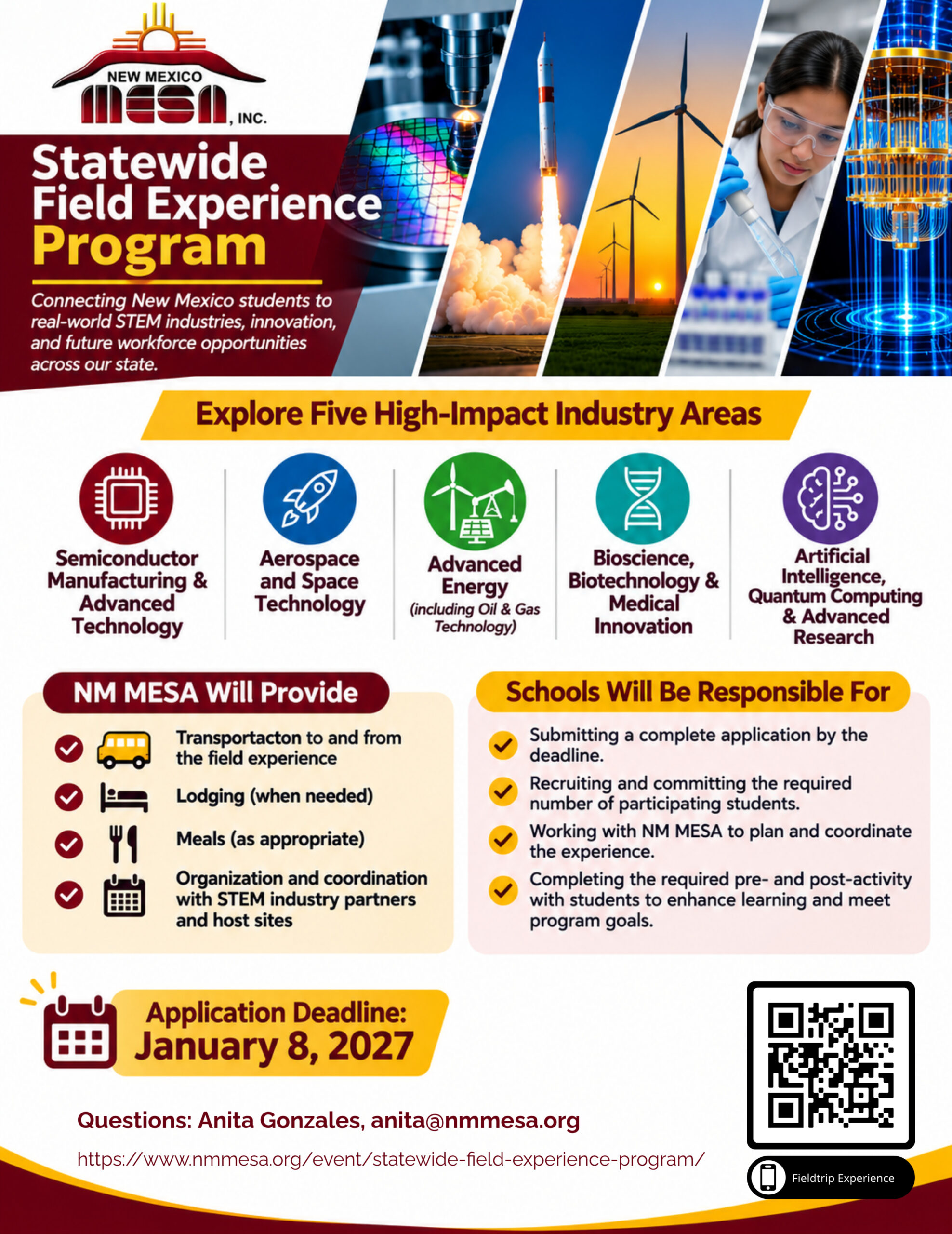
The NM MESA STEM Field Experience Program provides students with meaningful, standards-connected experiences with STEM industries, employers, professionals, colleges, research facilities, and other STEM organizations throughout New Mexico.
Through each Field Experience, students will:
- Explore STEM careers and career pathways available in New Mexico.
- Connect classroom learning to authentic STEM applications.
- Interact with STEM professionals and learn about their education and career journeys.
- Observe how mathematics, science, engineering, technology, communication, teamwork, and problem solving are used in the workplace.
- Develop questions and gather information through direct observation and interaction.
- Reflect on their interests, skills, and possible future educational and career pathways.
- Better understand the role STEM industries play in their communities and in New Mexico.
School Application
NM MESA schools must apply for support to participate in a STEM Field Experience. Applications will collect:
School Information
- School and Region
- NM MESA advisor
- Estimated number of students
Requested Experience
- Preferred STEM industry or career area
- Requested organization/site, if known
- Preferred dates or time period
- Any transportation or accessibility needs
- Requested specific site or experience.
Responsibilities
Depending upon the experience and available resources, NM MESA will:
- Schedule and coordinate experience.
- Help coordinate transportation or other allowable expenses.
- Provide the required Pre-Experience and Post-Experience activities.
- Provide monetary support for the experience: travel, lodging, meals, any needed supply cost
Schools receiving Field Experience assistance agree to actively participate in the planning and educational components of the program. The advisor/school agrees to:
- Respond to NM MESA and host organization requests in a timely manner.
- Provide required school and student information.
- Recruit the required number of students established for the experience.
- Obtain school/district approvals and student permission forms.
- Arrange appropriate school supervision.
- Communicate expectations to participating students.
- Complete the required NM MESA Pre-Experience Activity with students.
- Prepare students with appropriate background information.
- Ensure students arrive prepared with questions for STEM professionals.
- Reinforce appropriate workplace behavior.
- Complete the required NM MESA Post-Experience Activity.
- Provide participation and evaluation information requested by NM MESA.
Industry Targets
1. Semiconductor Manufacturing & Advanced Technology
Proposed/Sample Host: Intel Corporation – Rio Rancho, New Mexico
Student Focus: Students will explore semiconductor manufacturing, microchip technology, advanced packaging, robotics, automation, and precision manufacturing. Experiences may highlight how computer chips are designed, manufactured, tested, and integrated into modern technology. Students will learn about cleanroom environments, quality control, and the importance of mathematics, engineering, and technology in high-tech manufacturing.
Potential Careers: Semiconductor Manufacturing Technician, Electrical Engineer, Process Engineer, Mechanical Engineer, Robotics and Automation Technician, Materials Scientist, Quality Control Specialist, and Industrial Engineer.
2. Aerospace and Space Technology
Proposed/Sample Hosts: Spaceport America, New Mexico aerospace companies, Air Force Research Laboratory (AFRL), and university aerospace research programs.
Student Focus: Students will explore aerospace engineering, space exploration, rocket propulsion, satellite technology, flight systems, and uncrewed aircraft systems. Experiences may introduce students to aircraft and spacecraft design, testing, simulation, materials science, and the role of advanced technology in aerospace innovation. Students will learn how STEM professionals solve complex engineering challenges and support New Mexico’s growing aerospace industry.
Potential Careers: Aerospace Engineer, Avionics Technician, Mechanical Engineer, Flight Operations Specialist, Drone/UAS Technician, Software Developer, Propulsion Engineer, and Aerospace Systems Technician.
3. Advanced Energy
Proposed/Sample Hosts: Pattern Energy, New Mexico renewable energy facilities, oil and gas technology companies, electric utilities, energy storage facilities, and energy research programs at New Mexico universities and national laboratories.
Student Focus: Students will explore advanced energy technologies, including wind, solar, oil and gas, energy storage, and electrical grid systems. Experiences may highlight renewable energy generation, advanced drilling and extraction technologies, automation, remote monitoring, environmental technologies, and energy efficiency. Students will examine how engineering, mathematics, data analytics, and emerging technologies are used to produce, manage, and distribute energy while addressing reliability, safety, and environmental challenges.
Potential Careers: Renewable Energy Technician, Petroleum Engineer, Electrical Engineer, Energy Systems Engineer, Wind Turbine Technician, Solar Energy Technician, Geoscientist, Automation and Instrumentation Technician, Environmental Scientist, and Grid Operations Specialist.
4. Bioscience, Biotechnology & Medical Innovation
Proposed/Sample Hosts: University of New Mexico Health Sciences Center, New Mexico bioscience and biotechnology companies, medical research laboratories, hospitals and/or providers, medical device manufacturers, and healthcare technology organizations.
Student Focus: Students will explore biotechnology, biomedical engineering, medical research, healthcare technology, and innovations that improve patient care. Experiences may highlight medical devices, diagnostic testing, genetics, laboratory research, medical imaging, robotics, and the use of technology and data in healthcare. Students will discover how science, engineering, and technology contribute to medical breakthroughs and help address healthcare challenges, including those facing rural New Mexico.
Potential Careers: Biomedical Engineer, Biotechnology Technician, Medical Laboratory Scientist, Clinical Research Specialist, Biomedical Equipment Technician, Bioinformatics Specialist, Medical Device Engineer, Geneticist, Healthcare Technology Specialist, any medical profession.
5. Artificial Intelligence, Quantum Computing & Advanced Research
Proposed/Sample Hosts: Sandia National Laboratories, Los Alamos National Laboratory, Roadrunner Quantum Lab, Central New Mexico Community College quantum workforce programs, and university research or industry centers specializing in artificial intelligence, computing, and emerging technologies.
Student Focus: Students will explore artificial intelligence, machine learning, quantum computing, cybersecurity, advanced computing, and scientific research. Experiences may introduce students to data analysis, computer programming, algorithms, quantum technologies, computational modeling, and advanced research applications. Students will learn how emerging technologies are being used to solve complex problems in healthcare, national security, energy, manufacturing, and scientific discovery.
Potential Careers: Artificial Intelligence Engineer, Data Scientist, Software Developer, Quantum Computing Technician, Quantum Research Scientist, Cybersecurity Analyst, Computer Engineer, Machine Learning Specialist, and Research Engineer.
Additional Information
- Applications are due to NM MESA by January 8, 2027.
- Final selection and proposed sites will be given by January 15, 2027.
- Upon selection, all requested information will be due to NM MESA no later than 3 weeks before the trip to include: student information, chaperone information, transportation request, lodging request, meal request, and any other required information for the experience.
- Any questions, please contact Anita Gonzales, anita@nmmesa.org